Manual.ly Logo

JBL Aquaristic ProAquaTest Lab Instrukcja-Obslugi

0,0 · 0 Oceny

Instrukcja PDF · 65 Strony

Polski

M: QW-35-FL
strona

/ 65

Loading...
20bbaef5bdec311f8d8e156c4e1fe9d6e449 page 9
16 17
deciency. Iron and some other trace elements are only sta-
ble in water for a limited time, even if they are bound to so-
called chelators, as is usual in modern fertilisers. In addition
any tap water added is usually iron-free. Therefore, the iron
content needs to be monitored regularly with this test and re-
plenished if necessary. Cncentrations as low as 0.1–0.2 mg/l
are sufcient for good plant growth. In very densely planted
aquariums, values of up to 0.6 mg/l can also be useful. In
marine water, values of up to 0.05 mg/l are recommended.
Procedure:
1. Rinse both test vials several times with the water to be
tested.
2. Use the enclosed syringe to ll each of the test vials with
5 ml of sample water.
3. Add 5 drops of Fe reagent to one of the two test vials and
mix by swirling. Allow to stand for 10 minutes until the
colour has developed completely.
4. Place both test vials in the grey comparator block: Place
the vial with added reagent at the smooth end and the
vial with untreated sample water (blank sample) at the
notched end of the comparator block.
5. Place the comparator block with the two test vials on the
colour chart in such a way that the notch points to the
values and move it on the colour chart until the colour of
the sample mixed with reagents corresponds as closely
as possible to the colour under the blank sample.
6. Read the iron content in the notch of the comparator.
Note:If you decide to use the JBL PRO AQUATEST NH
4
at
the same time, make sure you don’t mix up the measuring
vessels of either set. Traces of the JBL PRO AQUATEST
NH
4
left inside the measuring vessel may result in too high
readings in the iron test.
Correcting deviating values:
Too low: Fertilise with ferrous fertilisers from the JBL ferti-
liser range (e.g. JBL Ferropol).
Too high: Carry out the corresponding partial water change.
JBL PRO AQUATEST K
Features: JBL PRO AQUATEST K is an easy-to-use turbid-
ity test for the routine monitoring of the potassium content in
fresh and marine water.
Why test? Potassium is one of the macroelements which is
very effectively absorbed within a few hours and temporarily
stored by plants in fresh water. Growing plants require more
potassium compared to other elements. As a result, potas-
sium concentrations can drop to a minimum range, causing
plant growth to stagnate, even if the aquarium water is ferti-
lised regularly. Potassium deciency initially leads to chloro-
tic spots on the edges of the leaf, which gradually increase
and then turn into grey-brown necroses. The leaves may
crinkle or curl. In Central European tap water, potassium is
usually a decient element compared to in natural biotopes
and this especially applies to calcium and magnesium con-
centrations. For good plant growth, the potassium content
needs to be at around 10 mg/l, in aquariums with high il-
lumination (e.g. in so-called scapes) up to 30 mg/l can be
useful. Higher potassium values in aquarium water encour-
age the growth of green thread algae. Potassium is present
in seawater in concentrations of about 380–400 mg/l, but is
only consumed in small quantities. Excessively high potas-
sium contents can be dangerous for sensitive animals such
as shrimps. The potassium content of the aquarium water
needs to be measured on a daily basis initially. This enables
the needs of the plants to be determined and the dosage of
the fertiliser can be carried out accordingly. Afterwards, rou-
tine measurements can be carried out after longer intervals.
Procedure:
Freshwater:
1. Rinse the measuring tube (plastic) and the tube (glass)
for the potassium content reading several times with the
water to be tested.
2. Using the syringe supplied, ll 15 ml of sample water into
the measuring tube.
3. Add 10 drops of reagent 1 and mix by swirling.
4. Add 1 large level measuring spoon (broad end of the
enclosed double-ended spoon) of reagent 2 and swivel
slightly for about 30 seconds until the powder has dis-
solved. The water becomes whitish and cloudy. Leave to
stand for 1 minute and then swirl slightly again.
5. Place the glass tube for reading the potassium content
reading on the cross of the colour card.
6. The following procedure should be carried out in bright,
diffuse light. Pour the´ turbid water from the measuring
tube into the reading tube until the turbidity means the
cross on the colour card is no longer visible from above.
7. The potassium content can now be read on the scale of
the tube (bottom of the meniscus).
Marine water:
1. Fill 10 ml sample water with distilled water to 300 ml.
2. Follow the same steps as for fresh water.
3. Multiply the test result by a factor of 30.
Correcting deviating values:
Too low: In freshwater aquariums fertilise with potassium-
containing fertilisers from the JBL ProScape range. We do
not recommend an additional dosage in marine water be-
cause potassium is toxic for various organisms.
Too high: Repeat the measurement after 24 hours. If the
value is still too high, carry out the corresponding partial
water change.
JBL PRO AQUATEST Cu
Features: JBL PRO AQUATEST Cu is an easy-to-use color-
imetric test to routinely determine the copper content in fresh
and marine water aquariums, and in garden ponds. A com-
pensation method developed by JBL allows reliable results
to be obtained even in slightly discoloured water (caused by
peat ltering or disease treatment etc.).
Why test? Copper is a heavy metal which is on the one
hand indispensable as a trace element for plant and animal
organisms. On the other hand it has a devastating effect
as a cell poison (cytotoxin) above a certain concentration.
Copper mainly reaches the aquarium in tap water, as cop-
per pipes were often used for water installation. If the water
remains in such pipes for a longer period of time, consid-
erable amounts of copper can dissolve. The water in the
pipe should therefore be drained before use. For the same
reason, do not use rainwater that has owed over copper
gutters. And make sure the tools you use when setting up
your aquarium or pond are copper-free. A controlled entry
of copper takes place through the application of medications
against parasitic sh diseases, as well as with some algae-
killing agents. The copper concentrations prescribed for this
can be tolerated by sh for a certain time while parasites,
etc., start dying off immediately.
Please note: Copper quickly forms water-insoluble com-
pounds which form deposits on the ground. The JBL PRO
AQUATEST Cu only detects copper dissolved in water.
Procedure:
1. Rinse both test vials several times with the water to be
tested.
2. Use the enclosed syringe to ll each of the test vials with
5 ml of sample water.
3. Add 5 drops of reagent 1 to one of the two test vials and
mix by swirling. Then add 5 drops of reagent 2 and mix
again. Allow to stand for 15 minutes until the full colouring
develops.
4. Place both test vials in the grey comparator block: Place
the vial with added reagent at the smooth end and the
vial with untreated sample water (blank sample) at the
notched end of the comparator block.
5. Place the comparator block with the two test vials on the
colour chart in such a way that the notch points to the
values and move it on the colour chart until the colour of
the sample mixed with reagents corresponds as closely
as possible to the colour under the blank sample.
6. Read the copper content in the notch of the comparator.
Correcting deviating values:
Too low: The value should always remain below the detec-
tion limit (except for some special treatments).
Too high: Regular use of JBL water conditioners, such as
JBL Biotopol or ltering with JBL’s high performance acti-
vated carbon. Water-insoluble copper compounds can only
be eliminated by removing the complete substrate.
JBL PRO AQUATEST O
2
Features: JBL PRO AQUATEST O
2
is an easy-to-use colori-
metric test for the routine monitoring of the oxygen content
in fresh and marine water aquariums, and in tap and garden
pond water, within a range of 1–10 mg/l (ppm).
Why test? All animals living in water need oxygen to
breathe. Even the „invisible helpers“ in aquariums and
ponds, the cleansing bacteria, are dependent on a suf-
cient oxygen content for the conversion of ammonium to
nitrate. The oxygen supply they need can be safeguarded
by adequate planting. In aquariums and ponds with little or
no planting and in marine aquariums, the oxygen content
always needs to be kept at the appropriate saturation value
with the help of technical equipment. The saturation value
depends on the water temperature (see table on last page).
Plants are able to exceed this saturation value through their
assimilation activity. In well planted aquariums and ponds,
for example, values can be found towards the end of the
lighting period, which are 1 to 2 mg/l higher than the satura-
tion value.
Procedure:
1. Rinse the measuring vessel several times with the water
to be tested.
2. Fill the measuring vessel to the brim with the water to be
tested by immersing it in water and place it on a water-
proof surface.
3. Add 6 drops of O
2
reagent 1 and 6 drops of O
2
reagent
2 slowly one after the other, until the measuring vessel
overows.
4. Avoiding bubble formation, close the measuring vessel
bubble-free with the enclosed cap and shake vigorously
for approx. 30 seconds.
5. Remove the cap from the measuring vessel and add 6
drops of O
2
Reagent 3.
6. Close the measuring vessel again (bubbles no longer
matter) and shake vigorously for approx. 30 seconds. Al-
low to stand for 10 minutes until the full colouring devel-
ops.
7. Move the measuring vessel back and forth approx. 3–5
cm above the white part of the colour chart and select the
colour with the best possible match.
8. Read the oxygen content off the relevant colour eld.
Correcting deviating values:
Too low: Put in more plants and/or improve care of exist-
ing plants, e.g. by installing a CO
2
supply unit (JBL ProFlora
CO
2
kit). Improve ventilation, e.g. with a JBL ProSilent air
pump and/or improve water movement on the surface with
ow pumps, protein skimmers (marine water) or in garden
ponds with stronger pumps (pond lters) in conjunction with
a waterfall or watercourse.
Too high: Not applicable.
JBL PRO AQUATEST CO
2
Direct
Features: JBL PRO AQUATEST Ca is an easy-to-use titra-
tion test to determine the carbon dioxide content of fresh-
water.
Why test? Carbon dioxide (CO
2
) is the most important plant
nutrient. The consumption of CO
2
differs from aquarium to
aquarium and depends, amongst other things, on the fol-
lowing factors: number and demands of plants, carbonate
hardness, water movement and light. Fertilisation with CO
2
is usually done with a CO
2
fertiliser system. In the aquarium
water, a CO
2
content between 15 and 30 mg / l is recom-
mended. This range is safe for sh and at the same time en-
sures luxuriant plant growth. 20–25 mg/l CO
2
has proven to
be ideal. In special aquariums with a large number of plants,
so-called scapes, higher values of up to 35 mg/l may be re-
quired. With this test you can determine the CO
2
content of
your aquarium water in mg/l and thus monitor the setting of
your CO
2
fertiliser system.
Please note: When fertilising with so-called liquid carbon,
fertiliser monitoring with JBL PRO AQUATEST CO
2
Direct is
not possible because these fertilisers do not contain CO
2
but
other carbon compounds.
Procedure:
1. Rinse the measuring vessel and syringe several times
with the water to be tested.
2. Using the syringe, insert 20 ml of bubble-free sample
water into the measuring tubes.
3. Place the measuring tube on both elds of the enclosed
colour chart.
4. Pour 5 drops of reagent 1 into the measuring tube on the
white eld and swirl it until it is mixed.
5. Add reagent 2 drop by drop. After each drop, swirl and
count the drops until a pink colour is obtained which re-
mains stable for 60 seconds and corresponds to the col-
our in the second measuring tube on the pink colour eld.
To compare the colours, look into the tubes from above.
6. The number of drops multiplied by 2 gives the carbon di-
oxide content in mg/l. Example: 10 drops of reagent 2 =
20 mg/l CO
2
.
Since other acids in the water impair the measurement, a
blank value must also be determined. To do this, take a wa-
ter sample of 100 ml and aerate it for 15 min using a JBL
ProSilent air pump with an air stone. Then determine the
blank value according to the instructions given above.
Result–blank value = actual carbon dioxide concentration
in mg/l.
Correcting deviating CO
2
values:
Too low: Add carbon dioxide to the aquarium using a JBL
ProFlora CO
2
fertiliser system.
Too high: Aerate the aquarium using a JBL ProSilent air
pump.
CO
2
table
Special feature: The CO
2
table enables you to determine
the carbon dioxide content through the carbonate hardness
(KH) and the pH value of the water. This method should only
be used if no pH-lowering substances, such as nitrate or
peat, are in the water.
Why test?
Carbon dioxide (CO
2
) is the most important plant nutrient.
The consumption of CO
2
differs from aquarium to aquarium
and depends, amongst other things, on the following factors:
number and demands of plants, carbonate hardness, water
movement and light. Fertilisation with CO
2
is usually done
en
en
en
en
en

Rozmawiaj z instrukcją obsługi JBL Aquaristic ProAquaTest Lab dzięki AI

Otrzymuj natychmiastowe odpowiedzi AI z instrukcji obsługi JBL Aquaristic ProAquaTest Lab

Zapytaj o JBL Aquaristic ProAquaTest Lab. Odpowiedzi pochodzą z tej instrukcji, wraz ze stronami, na których są oparte.

ProAquaTest Lab Harmonogram konserwacji

Codziennie
Mierz zawartość magnezu w akwarium słodkowodnym

Początkowo mierz codziennie, aby określić potrzeby roślin i dawkowanie nawozu. Następnie przejdź na dłuższe interwały.

Pokaż w instrukcji (strona 3)
Codziennie
Mierz zawartość potasu w akwarium słodkowodnym

Początkowo mierz codziennie, aby określić potrzeby roślin i dawkowanie nawozu. Następnie przejdź na dłuższe interwały.

Pokaż w instrukcji (strona 9)
M: qwen/qwen3.8-flash

Zadaj Pytanie

0/1000

Czy polecasz ProAquaTest Lab?

Tak Nie

Najczęściej zadawane pytania

A

Aby zapewnić dokładne wyniki, wypłucz wszystkie naczynia wielokrotnie wodą próbkową przed testowaniem. Trzymaj pipety w pionie, aby uniknąć pęcherzyków powietrza. Postępuj zgodnie ze specyficznymi czasemami oczekiwania dla rozwoju koloru. Porównuj kolory względem wykresu na białym tle. Użyj dostarczonych strzykawek i bloków konfirmatornych do spójnych objętości.

Czy ta odpowiedź była pomocna?

A

Wahania pH mogą szkodzić organizmom wodnym. Nagłe zmiany są szczególnie stresujące. Zabarwiona woda może zakłócać odczyty, ale metody kompensacji pomagają. Zawsze mierzy o tej samej porze dnia, ponieważ światło wpływa na poziomy CO2 i pH. Unikaj testowania bezpośrednio po dodaniu chemikaliów lub pokarmu.

Czy ta odpowiedź była pomocna?

A

Sprawdzaj krytyczne parametry takie jak pH i amoniak regularnie, zwłaszcza w nowych zestawach. Testuj składniki odżywcze takie jak azotany i fosforany co miesiąc, gdy system jest stabilny. Sprawdzaj KH i GH co tydzień, aby monitorować trendy twardości. Testuj poziomu tlenu, jeśli ryby wykazują oznaki stresu lub w mocno obsadzonych zbiornikach. Częstotliwość zależy od gęstości obsadzenia i wielkości zbiornika.

Czy ta odpowiedź była pomocna?

A

Tak, podręcznik obejmuje akwaria słodkowodne, morskie i stawy ogrodowe. Specyficzne testy istnieją dla stawów Koi z wysoką gęstością obsadzenia. Testy ogólnego utwardzenia i pH stosują się do większości środowisk słodkowodnych. Testy CO2 są specyficzne dla akwariów roślinnych z aktywnymi cyklami wzrostu roślin.

Czy ta odpowiedź była pomocna?

A

Wysoki amoniak wskazuje na problem z filtrem biologicznym. Natychmiast wykonaj dużą częściową wymianę wody. Dodaj korzystne bakterie, aby przywrócić cykl azotowy. Sprawdź, czy niedawno stosowane leki nie zaszkodziły korzystnym bakteriom. Upewnij się, że karmienie jest ograniczone, aż poziomy wrócą do bezpiecznych limitów. Monitoruj pH, ponieważ wpływa na toksyczność amoniaku.

Czy ta odpowiedź była pomocna?

A

Skoryguj niską twardość węglanową, dodając odczynniki do wody JBL zawierające wodorowęglany. Możesz też użyć mieszanin soli mineralnych przeznaczonych do akwariów. Unikaj zmiękczania wody, jeśli jest już zbyt niska. Monitoruj ściśle po dostosowaniu, aby zapobiec wahaniom pH. Przetestuj ponownie po 24 godzinach, aby potwierdzić stabilność.

Czy ta odpowiedź była pomocna?

A

Przechowuj odczynniki suche w temperaturze pokojowej w oryginalnym opakowaniu. Trzymaj je z dala od bezpośredniego światła słonecznego i źródeł ciepła. Upewnij się, że pipety są suche z zewnątrz przed powrotem do butelek. Nie mieszaj nakrętek między różnymi zestawami testowymi. Sprawdzaj daty ważności regularnie, ponieważ stare odczynniki mogą dawać niedokładne wyniki.

Czy ta odpowiedź była pomocna?

M: QW-35-FL

Zalety i Wady

Zalety

  • Kompleksowy zakres testów obejmujący wszystkie kluczowe parametry dla zróżnicowanych zestawów wodnych, w tym słodka woda, morska i stawy ogrodowe
  • Zaawansowana technologia kompensacji zapewnia niezawodne wyniki nawet w wodzie zabarwionej filtrowaniem torfu lub zabiegami
  • Szczegółowe procedury minimalizują błędy użytkownika i zawierają pomoce wizualne takie jak karty kolorów dla łatwej interpretacji pomiarów
  • Odczynniki są stabilne i skuteczne, gdy przechowywane prawidłowo, umożliwiające długoterminowe spójne monitorowanie chemii wody
  • Specjalne narzędzia ułatwiają proces testowania, czyniąc go dostępnym dla początkujących, pozostając dokładnym dla ekspertów
VS

Wady

  • Niektóre testy wymagają odczytu kolorów w ciągu 15 minut, aby zapewnić dokładność przed zmianą koloru roztworu
  • Użytkownicy muszą upewnić, że naczynia testowe nie są mieszane między różnymi zestawami testowymi, aby uniknąć krzyżowego zanieczyszczenia próbek
  • Precyzja zależy od starannego liczenia kropli i trzymania pipet w pionie, co wymaga uwagi na szczegóły
  • Korekta wysokich poziomów toksyn często wymaga natychmiastowych dużych objętościowych wymian wody, co może być uciążliwe
  • Odczynniki mogą ulec degradacji w czasie, jeśli nie są przechowywane w oryginalnym opakowaniu z dala od źródeł ciepła i wilgoci
M: QW-35-FL

Produkt Specyfikacja

Zakres

Wartości wody

Typ

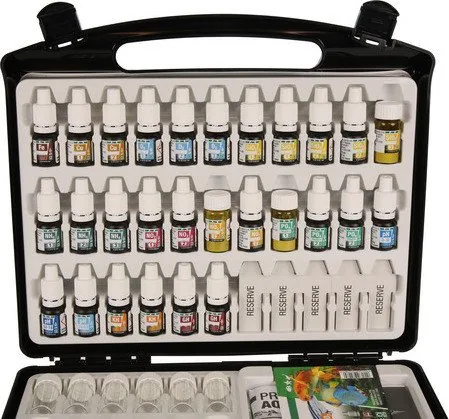
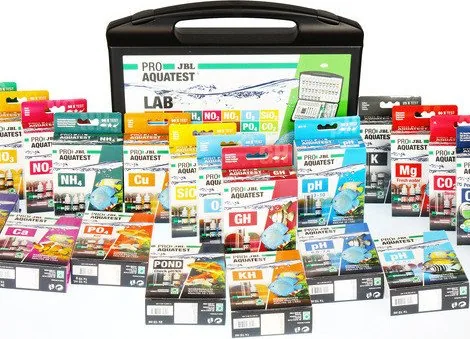
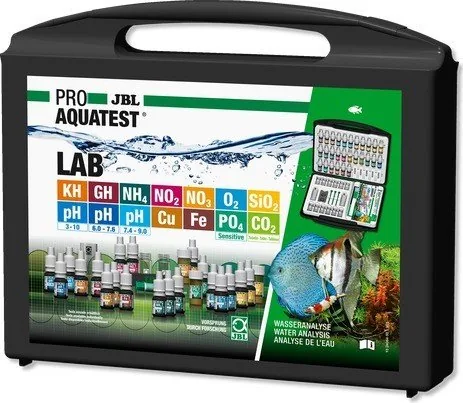
Test wody (pH (3 zakresy), Twardość węglanowa, Twardość ogólna, Fosforany, Nitryty, Azotany, Żelazo, Miedź, Krzemiany, Tlen, Amon, Amoniak, CO2 pośredni), Zestaw testowy

Wymiary

38,20x8,51x31,80 cm (SzxWysxGłb)

Waga

1,27 kg

M: QW-35-FL

Opis Produktu

Opanowanie chemii wody w akwarium

Utrzymywanie zdrowego środowiska wodnego wymaga precyzyjnego monitorowania chemii wody, aby zapewnić dobrobyt wszystkich organizmów żyjących wewnątrz. Podręcznik zestawu testowego JBL Pro AquaTest Lab Test Case Manual zapewnia niezbędne wskazówki dla hobbystów, którzy domagają się doskonałości w swoich zestawach akwariowych, aby utrzymać najwyższy stan. Ta kompleksowa kolekcja zapewnia, że Twoje ryby i rośliny rozwijają się w optymalnych warunkach, dostarczając szczegółowych instrukcji dla różnych metod analizy stosowanych dzisiaj.

Podstawowe metody testowania dla klarowności

Jakość wody determinuje sukces każdego zestawu akwariowego niezależnie od konkretnych gatunków, które hodujesz. Niezależnie od tego, czy hodujesz zwierzęta słodkowodne lub morskie, czy koi w stawie, różne parametry wymagają szczególnej uwagi dla stabilności. Podręcznik szczegółowo opisuje zaawansowane metody miareczkowe i kolorymetryczne, zaprojektowane dla dokładności i łatwości użycia. Testy miareczkowe takie jak KH i GH wykorzystują dokładne liczenie kropli do określenia poziomów twardości w czasie. Testy kolorymetryczne takie jak pH i niezbędne składniki odżywcze polegają na kartach kolorów dla jasnych i czytelnych wyników w szybkich sprawdzianach. Każdy test zawiera kroki procedury, aby zminimalizować błędy użytkownika podczas procesu testowania próbek wody. System skutecznie kompensuje barwienie wody spowodowane filtrowaniem torfu lub leczeniem, zapewniając niezawodność nawet w trudnych warunkach.

Naczelne parametry objęte dla zdrowia

Zrozumienie swojego profilu wody jest kluczowe dla zapobiegania niebezpiecznym wahaniom, które szkodzą wrażliwym stworzeniom. Testy twardości takie jak Pro AQUATEST GH i KH zapobiegają niebezpiecznym wahaniom pH, które znacznie szkodzą wrażliwym stworzeniom. Poziomy pH między określonymi zakresami pasują do różnych gatunków od kwaśnych wód słodkowodnych do alkalicznych zbiorników morskich idealnie. Testy składników odżywczych monitorują złożone cykle azotu takie jak Ammoniak, Azotyny i Azotany, aby dokładnie śledzić funkcję systemu. Poziomy fosforanów i krzemianów pomagają zapobiec uporczywemu zakwitu glonów, które mogą udusić Twój zbiornik i zabić ryby. Elementy śladowe takie jak Żelazo i Miedź są niezbędne dla wzrostu, ale muszą być ściśle kontrolowane, aby uniknąć ryzyka toksyczności. Poziomy tlenu zapewniają wsparcie dla żywości ryb i bakterii, podczas gdy nawożenie CO2 wspiera bujny wzrost roślin w zbiornikach z roślinami.

Pielęgnacja i korekty dla stabilności

Utrzymywanie parametrów stabilnych unika stresu i wybuchów chorób w Twoim ekosystemie w długim terminie. Jeśli wartości odbiegają od zalecanych zakresów, przewodnik oferuje specyficzne kroki korekcyjne w celu dostosowania naprawy problemów. Zbyt niska twardość wymaga dodawania soli mineralnych, podczas gdy nadmiar sugeruje używanie filtracji odwrotnej osmozy do jej zmniejszenia. Niedobory składników odżywczych potrzebują specyficznych nawozów z asortymentu ProScape dostępnego online łatwo. Wysokie poziomy toksyn wymagają natychmiastowej wymiany wody lub wprowadzenia filtrów biologicznych w celu przywrócenia równowagi. Instrukcje przechowywania zapewniają, że odczynniki pozostają skuteczne dla przyszłych okresów testowania przed ich wygaśnięciem. Pipety należy trzymać w pionie, aby zapobiec pęcherzykom powietrza podczas dozowania odczynników. Regularne monitorowanie zapobiega nieoczekiwanym niespodziankom w Twojej rutynie konserwacji dla Twoich zbiorników. Postępując zgodnie z wytycznymi Podręcznika zestawu testowego JBL Pro AquaTest Lab Test Case Manual, właściciele akwariów mogą osiągnąć klarowność wody i stabilność dla swoich zwierząt.

M: QW-35-FL

© Copyright 2026 Manual.ly